Installation Lessons and Performance
SITE LOCATION:
Mountain Region Upper Northwest United States
CONTAMINATION:
Dissolved phase Chlorinated Volatile Organic Compounds (CVOC’s).
OBJECTIVE:
Installation of a horizontal air sparge (AS) curtain to create a hydraulic containment barrier to mitigate the downgradient transport of contaminants. This case study illustrates how a VertebraeTM well system can be installed in challenging drilling conditions.
BACKGROUND:
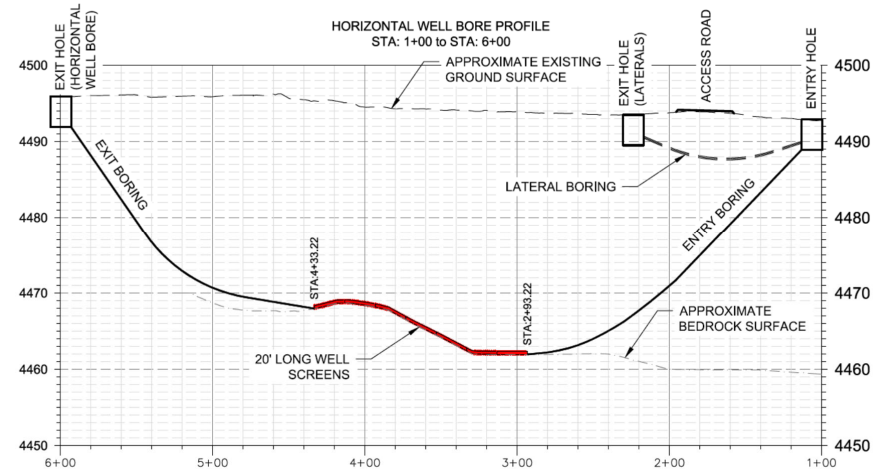
The installation involved Horizontal Directional Drilling (HDD) in an alluvial aquifer comprised of very coarse sand, gravel and basketball sized cobbles while following the contact surface with the underlying bedrock. The underlying bedrock required the bore to be drilled up slope hugging the bedrock surface with an elevation change of 7 feet over 150-foot drilling distance at depth. The site conditions made drilling and well installation extremely difficult.
The contaminants associated with the site range from petroleum constituents to chlorinated solvents. Several remedial strategies have been deployed at the site to address the large and variable contaminant plume(s). A vertical well AS/SVE system was installed at the site to create an AS curtain to reduce the CVOC’s in the alluvial aquifer and to control offsite plume migration from the facility. The AS/SVE system reduced and controlled the dissolved CVOC plume except during times of a reduced saturated thickness, overlying the bedrock. At this point the air flow was disproportionally being directed to the vertical
AS wells with the least saturated thickness. To overcome the issues related to air flow, a VertebraeTM well system was selected due to its horizontal screen orientation and the ability to install several independent well segments in one horizontal bore. Even though the VertebraeTM well system offered a solution to the air flow issues, all involved parties were still concerned by the nearly impossible drilling conditions for installing the horizontal bore and the VertebraeTM well system. However, EN Rx was confident that once installed, the VertebraeTM well system could successfully administer the air sparging treatment.
INSTALLATION ACTIVITIES
The first mobilization in November 2018 proved to be very challenging. Despite familiarity with the area (Rocky Mountain Region) and experience drilling in cobble, the initial HDD contractor broke tooling and was unable to finish the bore after only 60 feet of drilling. They were surprised by the difficulty and demobilized with winter weather approaching. This unsuccessful first event directed EN Rx to contract with a new, local HDD contractor to return to the facility in the spring of 2019. The local HDD contractor had a larger sized bore machine, more robust equipment for the drilling conditions, and more familiarity with this environment allowing them to complete the directional bore in such challenging lithology. The
contractor described the site conditions as some of the most difficult HDD conditions imaginable.
The VertebraeTM well system consisted of seven independent well segments, 20-foot-long – 1.5-inch nominal screens plumbed to land surface with 1.25-inch conveyance tubing. The installation of the seven independent VertebraeTM wells at the site involved 515 feet of HDD and was completed in five days, followed by one day of well development, one day of grouting, and one day of field testing.
The HDD contractor utilized a Vermeer 60 x 90 drill rig and a cobble bit to establish the pilot bore. The bore was then swabbed with a modified 10-inch roller bit. The picture below shows a comparison of a new drill bit on the right and the same drill bit after 150 feet of drilling at depth, on the left. Three bits were used to accomplish the 515-foot pilot bore.

SYSTEM PERFORMANCE RESULTS
EN Rx field tested the VertebraeTM well system to verify air flow rates for the AS treatment. Each individual VertebraeTM well segment achieved >40 cfm at ~15 psi (~2 cfm per linear foot of screen) exceeding the design flow rate. The total VertebraeTM well system with 7 segments is using 290 cfm for sparging.
CONCLUSIONS
The VertebraeTM well system provided an effective solution for administering the robust AS curtain and solved the air flow problems. Despite nearly impossible drilling conditions, the horizontal well system was successfully installed. The VertebraeTM well system is a cost-efficient option for installing wells in difficult drilling conditions. Initial data indicates that the Vetebrae™ system is functioning well, increasing dissolved oxygen and decreasing CVOC concentrations downgradient of the curtain wall. The ability to vary the air flow to small sections of the sparge curtain helps optimize curtain wall effectiveness across the area where saturated thicknesses vary considerably.